Discover the next generation of surface quality control at
Paint Expo 2026.
Visit Hall 1, Stand 1149 and explore smarter ways to control surface appearance.
Plan your visit.
Which system is more suitable for detecting surface scratches, particularly fine or shallow line scratches on high-gloss surfaces — AESTHETIX or TAMS?
AESTHETIX is more suitable for detecting surface scratches, particularly fine or shallow line scratches on high-gloss surfaces. Its advanced imaging capabilities, including direct surface imaging and live feedback, allow for the visualisation and quantification of fine scratches, swirls, and other micro-scale defects that TAMS cannot reliably detect. TAMS, while excellent for measuring waviness and orange peel, is not designed for direct scratch detection or visualisation.
To determine which system, AESTHETIX or TAMS is more suitable for detecting surface scratches, especially fine or shallow line scratches on high-gloss surfaces, it is essential to compare their measurement capabilities, imaging technologies, and intended use cases.
Aesthetix
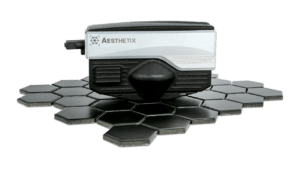
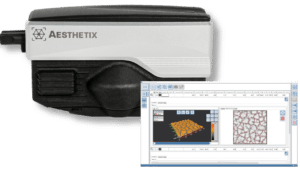
Technology:AESTHETIX is a modern, image-based gloss meter equipped with high-resolution CMOS cameras and advanced image processing. It captures both the reflected light image (for gloss, haze, sharpness/DOI) and direct surface images (for texture, defects, and uniformity).
Scratch Detection: The latest AESTHETIX models include a 0° camera system (surface imaging camera) that directly images the sample surface under controlled lighting. This allows for the detection and analysis of surface defects such as scratches, swirls, and holograms. The 0° camera, combined with a 10° point light source and a 45° ring light, can highlight fine line scratches and other surface imperfections that may not be visible using only traditional gloss measurement techniques.
Visualisation: The AESTHETIX provides live feedback and high-resolution images, making it possible to visually identify and quantify scratches and other surface defects. The instrument can distinguish between different types of surface damage (scratches, swirls, polishing marks) and is sensitive to directional defects due to its imaging capabilities.
Application:AESTHETIX is designed for comprehensive surface appearance analysis, including gloss, haze, DOI, contrast, and surface uniformity (texture, defects, orange peel). It is suitable for quality control in industries where visual appearance is critical, such as automotive, consumer electronics, and high-end manufacturing.
VS
TAMs
Technology:TAMS (TAMS surface analyser) is a dedicated instrument for measuring waviness (orange peel) and surface relief on high-gloss surfaces. It is widely used in the automotive and coatings industries for quantifying surface texture and orange peel effects.
Scratch Detection:TAMS is optimised for measuring longer wavelength surface deviations (waviness/orange peel) rather than micro-scale defects like fine scratches. While it can detect some surface irregularities, its primary focus is on texture and waviness, not the direct imaging or quantification of fine line scratches.
Visualisation:TAMS does not provide direct surface imaging. It generates surface profiles and waviness maps but does not offer the same level of visual defect detection as a camera-based system like AESTHETIX.
Application:TAMS is best suited for applications where the main concern is surface smoothness and the presence of orange peel or texture, not the detection of fine scratches or other localised defects.
Friction testing is used in the packaging industry to measure the slip resistance of a product, with the aim of predicting feeding and running speed on an automatic glueing, erecting, filling or packaging line.
Other industries that test for slip include the paper industry (e.g. for the automatic feeding of envelopes and banknotes) and plastic manufacturers (the frictional properties of packaging films).
A products slip resistance is characterised by its coefficients of friction:
Static coefficient of friction = Fs/N Dynamic coefficient of friction = Fd/N
Where Fs is the maximum static frictional force and Fd is the average dynamic frictional force. N is the Normal force, ie the force of gravity acting on the sample and test sled.
In practical terms, the static slip relates to the force required to get two resting surfaces moving, dynamic slip is the smaller force that is required to keep the surfaces moving once this initial “inertia” is overcome.
These values are expressed as ratios and do not have units, they are usually quoted as a decimal value between 0 and 1, for example, a surface might have a static slip coefficient of 0.35 and a dynamic slip coefficient of 0.18.
All methods of COF measurement involve preparing a sample into two flat pieces, the samples are placed together and a constant weight is applied to represent the normal force. One piece is fixed, and a gradually increasing force is applied to the second sample until the samples begin to slip against one another (Fd Max).
How to measure friction
Horizontal Plane (flatbed) Friction Testing
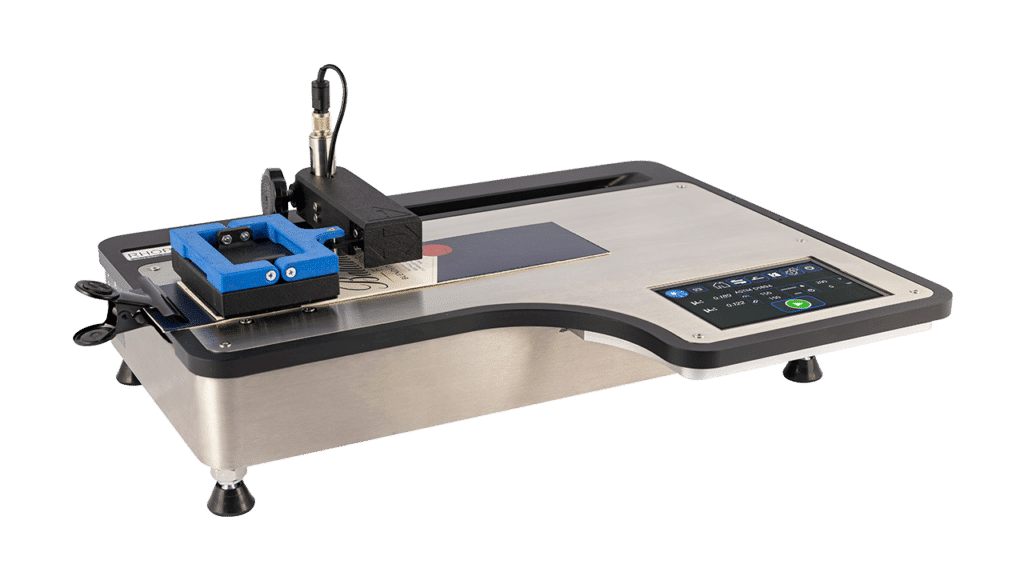
To measure Static and Dynamic coefficients of friction it is necessary to use a fixed bed instrument. These instruments use a motor to pull a sled across the sample, using a load cell to measure the forces.
Original instruments were converted tensile testers that used a cord to pull the sample, the use of a cord has now been removed from many friction measurement standards due to the uncertainty added by its own elasticity and problems with sample positioning.
The Universal Friction Tester uses mechanical linkages to apply the force and uses automatic sled placement for very accurate sample positioning with variable dwell time before testing.
How can Coefficient of Friction (COF) values relate to packaging speeds?
COF can often be related to the feeding and running attributes of products, for instance, U.V. varnished food cartons have a slip coefficient that is related to the formulation of the U.V. coating its cure and film weight.
Cartons that have a very low static coefficient of friction may have handling difficulties as they will tend to slide apart and are difficult to place into feeding hoppers.
In contrast, products which have a high coefficient of friction will tend to stick together and can be prone to misfeeding due to multiple cartons entering the packaging line.
Different packaging lines will often require products with specific surface frictional profiles to achieve their highest running and feeding speeds, it is only by measuring and specifying these values that a manufacturer can achieve maximum productivity.
What parameters affect Coefficient of Friction (COF) values?
COF is primarily influenced by the chemical composition of the surface and its surface profile, in packaging, this is often a coating applied to the packaging. Chemical additives are used to adjust the slip resistance, these additives are often waxes or silicones which change the profile on a molecular level and alter the atomic attraction of the surfaces.
Other important factors that affect COF are test speed, the normal force (mass of the sled), contact area and geometry of the sample, these values are often specified in the test method (ASTM D1894 and ISO 8295).
To provide the best experiences, we use technologies like cookies to store and/or access device information. Consenting to these technologies will allow us to process data such as browsing behaviour or unique IDs on this site. Not consenting or withdrawing consent, may adversely affect certain features and functions.
Functional
Always active
The technical storage or access is strictly necessary for the legitimate purpose of enabling the use of a specific service explicitly requested by the subscriber or user, or for the sole purpose of carrying out the transmission of a communication over an electronic communications network.
Preferences
The technical storage or access is necessary for the legitimate purpose of storing preferences that are not requested by the subscriber or user.
Statistics
The technical storage or access that is used exclusively for statistical purposes.The technical storage or access that is used exclusively for anonymous statistical purposes. Without a subpoena, voluntary compliance on the part of your Internet Service Provider, or additional records from a third party, information stored or retrieved for this purpose alone cannot usually be used to identify you.
Marketing
The technical storage or access is required to create user profiles to send advertising, or to track the user on a website or across several websites for similar marketing purposes.