
Sharpness (Aesthetix)
Sharpness is a surface appearance parameter that quantifies how clearly and crisply a surface reflects fine detail and edges in a mirrored image.
Parameter description
Sharpness indicates the edge clarity within a reflection rather than the overall brightness or gloss level. High sharpness values correspond to very clear, well‑defined edges and fine details in the reflected image, while low values indicate blurred, smeared or “soft” reflections that reduce the perceived quality and depth of finish.
How is it measured?
- The instrument illuminates the surface and captures a high‑resolution image of a reflected pattern or highlight at the specular geometry.
- Software analyses edge transitions and local contrast within the reflected pattern; sharp, high‑contrast edges produce high sharpness values, whereas widened, low‑contrast edges reduce the sharpness value, which is typically reported on a 0–100 scale.
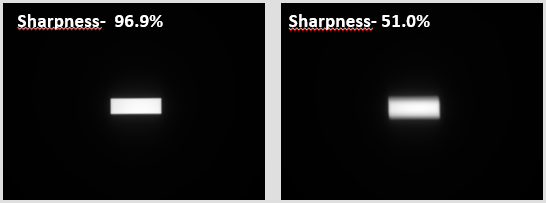
Sharpness measures the clarity of sharp edges visible in a reflection and is exceptionally sensitive to ultra-fine structures that only become visible at close viewing distances (typically under 20cm). In the example, two high-gloss surfaces show similar gloss and DOI values but the surface on the right has subtle micro-texture that softens edges in the reflection, reducing the quality of the finish.
Difference between Sharpness and DOI
- Sharpness concentrates on the local edge definition in the reflection, making it very sensitive to small amounts of blurring that soften fine details and lines.
- DOI (Distinctness of Image) evaluates the overall fidelity of the reflected image, responding more strongly to broader spreading and distortion caused by orange peel and larger‑scale texture than to subtle edge softening.
Applications
- Evaluating polishing quality and surface finish on automotive bodywork, piano and furniture lacquers, consumer electronics and decorative plastics where mirror‑like clarity is critical.
- Monitoring process changes (substrate preparation, coating formulation, application and curing) to minimise micro‑texture and orange peel that reduce edge clarity, ensuring consistent premium appearance across parts and batches.
Technical Specification
| Item | Specification / Value |
|---|---|
| Index name | S (Sharpness) |
| Description | Measures the clarity and definition of sharp edges and fine details visible in the reflected image |
| Unit | % (0–100%, higher values = crisper reflections) |
| Measurement geometry | Specular reflection at 60° (shared with gloss/DOI) |
| Measurement principle | Image‑based analysis of local edge contrast and edge width in the reflected pattern |
| Standard analysed area | 18 × 9 mm |
| Optional small spot | 4 × 2 mm |
| Other analysed areas | Effect / Texture / Polishing modules: up to 10 × 10 mm or 15 × 15 mm, depending on configuration |
| Sensitivity | Highly sensitive to ultra‑fine surface texture visible at viewing distances below ~20 cm |
| Measurement range | 0–100% |
| Repeatability (typical) | ±0.2% sharpness |
| Reproducibility (typical) | ±0.5% sharpness |
| Primary use | Discriminating very high‑gloss finishes by edge clarity, revealing micro‑texture not seen in gloss alone |