
Harmony (TAMS High Gloss)
Harmony (H) – High gloss mode
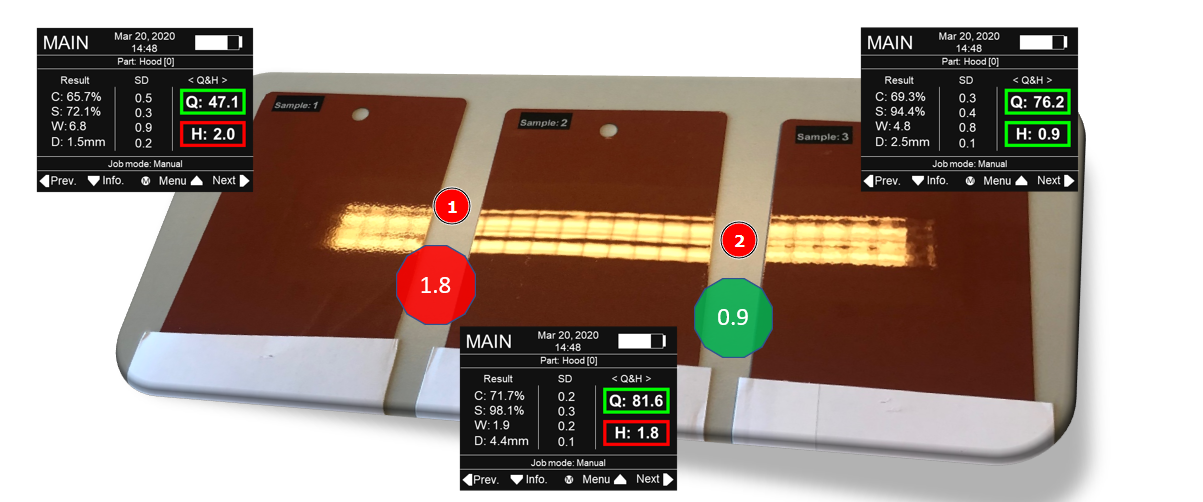
Comparing Samples 1 & 2 demonstrate poor harmony H=1.8 (1), Samles 2 & 3 show acceptable harmony H=0.9 (2)
Definition
Harmony (H) is a perception‑based index that quantifies how similar the surface texture of two high gloss painted parts appears when viewed side by side (for example fender/door or quarter panel/fuel flap). It expresses whether differences in orange peel and texture between parts are small enough to be acceptable to most observers.
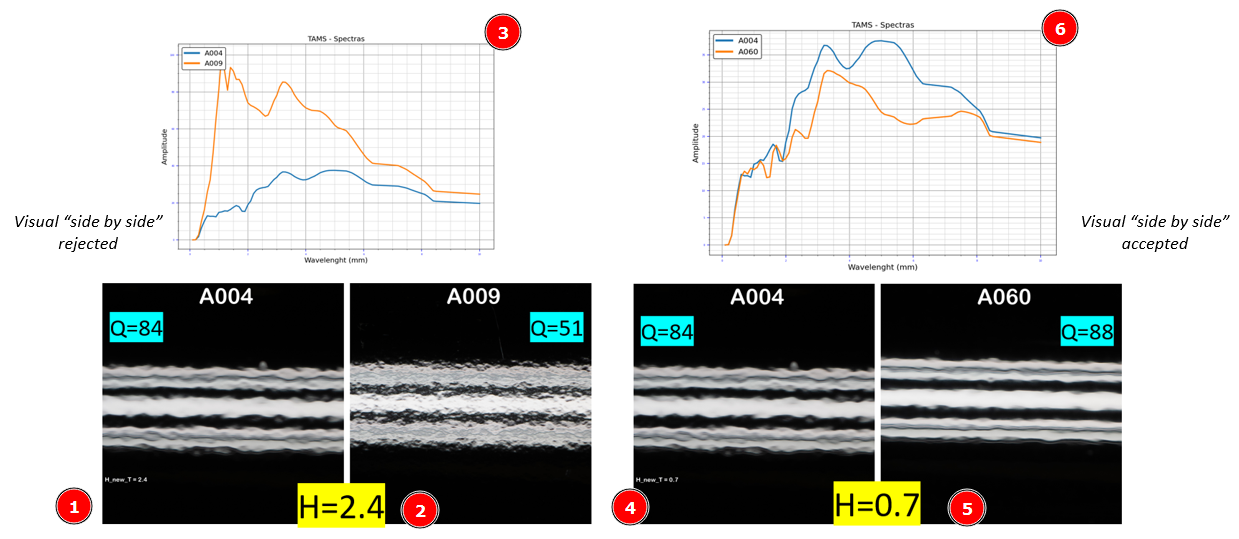
Panels (1) & (2) have dissimilar surface structure shown in the spectra (3) this results in a poor harmony H=2.4. Panels (4) and (5) have acceptable harmony H=0.7 and similar surface texture (6).
Unit and range
Harmony is a dimensionless index on the TAMS display, typically ranging from around 0.0 to 8.0 Lower values indicate good harmony (small perceived difference), while higher values indicate larger differences that are more likely to be seen as a mismatch. In practice, values below 1 are usually acceptable, whereas values clearly above 1 flag parts that may need process adjustment or rework.
Measurement conditions
Harmony is available in High Gloss Mode when the surface type is set to C‑Coat and the CC‑TAMS‑STD algorithm is selected. Harmony is calculated by comparing measurements from a reference surface (for example a master panel or agreed “good” part) to measurements from production parts, with each batch based on several readings per part to ensure stable averages.
Spectral Matching Score (SMS) – new Harmony basis
Harmony is now calculated using the Spectral Matching Score (SMS) method, which uses the complete surface texture spectrum from both surfaces being compared. Instead of relying only on differences in waviness and a single dominant texture size, the updated algorithm derives several spectral parameters from each surface, scales and weights them, and then combines them into the Harmony value. This spectral approach improves correlation with visual assessments and keeps the familiar Harmony (Hz) scale for users.
Role of waviness, dimension and sharpness
In the updated Harmony algorithm, the SMS method replaces the direct use of the Dimension (D) value in the calculation, but D is still shown on the TAMS display as a useful indicator when multiple dominant structure sizes are present. Because the full spectrum is used, sharpness‑related information from very short wavelengths is now included alongside waviness‑related components, so Harmony responds more closely to the texture features that observers actually see. Users should treat Harmony (H) as the primary acceptability index for panel‑to‑panel matching, while using D as a diagnostic aid rather than a direct quality criterion.
Typical interpretation
- H < 1.0: Panels are visually well matched in texture; differences are generally acceptable in production and in the showroom.
- H ≈ 1.0–2.0: Noticeable but often tolerable differences, which may still require attention on dark or premium Class A surfaces.
- H > 2.0: Clear texture mismatch; likely to draw attention and reduce perceived vehicle quality, typically prompting process optimisation or rework.