
Quality (TAMS High Gloss)
Quality (Q) – High gloss mode
Definition
Quality (Q) is a perception-based index that describes the overall visual appearance of a high gloss clear-coat surface. It combines contrast, sharpness and waviness into a single value that reflects how good or bad the finish looks to an observer.
Unit and range
Q is expressed in percent (%), from 0% (very poor, strongly distorted reflections) to 100% (mirror-like, premium appearance). Typical automotive clear-coats fall between these extremes depending on process and substrate.
Measurement conditions
Q is available in High Gloss Mode when the surface type is set to C-Coat and the CC‑TAMS‑STD algorithm is selected on TAMS. Measurements should be taken on near-flat, clean, defect-free areas; at least three readings are recommended before closing the batch to obtain averaged Q results.
Related parameters
The following sub-parameters are calculated for each measurement and used to derive Q:
- Contrast (C): Relative intensity difference between bright and dark areas in the reflected pattern, 0–100%. Higher values indicate deeper, more vivid reflections.
- Sharpness (S): Clarity of the reflected image across viewing distances, 0–100%. Lower values indicate haze or blurred reflections.
- Sharpness-Q (Sq): Internally scaled sharpness term (0–100%) used by the Quality algorithm; not normally displayed.
- Waviness (W): Degree of large-scale surface undulation or orange peel, typically from 0 (flat) to around 30 (very wavy).
- Dimension (D): Dominant structure size perceived at typical viewing distance, reported in millimetres.
Computation principle
Q is calculated using a proprietary algorithm that combines Contrast, Sharpness (including Sq) and Waviness to match human visual grading of clear-coat appearance. Higher contrast and sharpness increase Q, while higher waviness reduces it.
Colour dependence and advantage
An important advantage of the TAMS Quality index is that the basecoat colour is inherently taken into account through the contrast term when calculating Q. This allows Quality to be assessed consistently across different colours instead of assuming that all colours behave like a neutral reference.
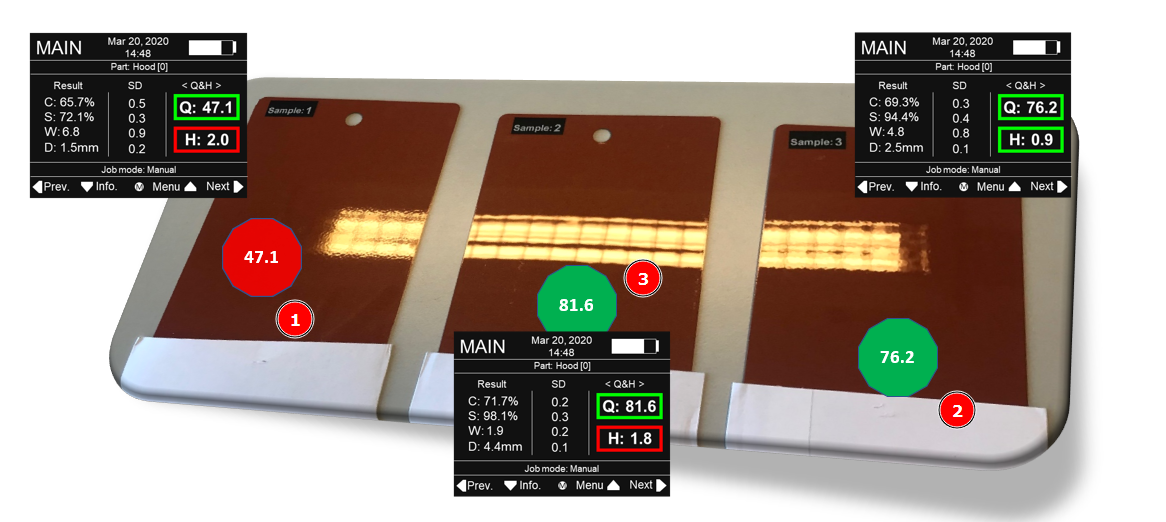
Three panels with medium (1)., good (2) and exceptional (3) quality.
Conventional instruments that control only surface waviness or DOI often ignore the effect of colour, even though colour strongly influences how defects are perceived by the customer. For example, on a black, high-contrast car, haze and poor DOI are highly visible because they reduce the depth of finish and dramatically lower perceived quality, while on a metallic silver car the same level of DOI and haze can be almost invisible to the end user. If both vehicles are controlled using only waviness and DOI limits, this can lead to unnecessary rework and over-processing on sensitive dark colours and, at the same time, an inappropriate focus on parameters that are less relevant for some lighter colours.
Typical interpretation
High Q values indicate smooth, glossy surfaces with clean, undistorted reflections; low Q values indicate visible texture, haze or orange peel that reduce perceived quality. Target Q limits can be set for production, with tighter bands used for premium or Class A surfaces.
Applications
Quality (Q) in high gloss mode is used wherever consistent visual appearance of coated surfaces is critical. Typical applications include:
- Automotive exterior body panels, bumpers, mirrors and add-on parts for meeting OEM appearance specifications and harmony targets across the vehicle.
- High gloss coatings on consumer electronics, appliances and furniture to differentiate premium finishes and control variation between batches or suppliers.
- Process development and troubleshooting for paint, clear-coat and polishing operations, where Q trends support optimisation of application, curing and sanding/buffing parameters and its colour sensitivity helps avoid over-processing or misjudging certain colours.