
Boring Thickness Module Overview
The Aesthetix Boring Thickness Module measures the individual layer thicknesses of a multi-layer coating system by imaging a precision-drilled conical crater (Säberg drill / "Säberg method") and converting the visible ring radii into micrometre values.
Where conventional non-contact thickness gauges (magnetic, eddy current) only return the total dry-film thickness, the boring method allows you to resolve each layer of the coating stack individually — primer, basecoat, clearcoat — from a single measurement.
Why Layer-Resolved Thickness Matters
Quality Control of Multi-Layer Systems
Modern paint and coating systems frequently consist of three or more functional layers. Each layer has its own role (corrosion protection, colour, gloss, weather resistance) and its own specified thickness window. A correct total dry-film thickness is not sufficient to prove that the system was applied correctly — a thick primer compensating for a thin topcoat passes a magnetic gauge but fails the actual specification.
Verification of Application Process
Boring thickness measurement is used in automotive OEM, architectural coatings, anti-corrosion coatings (ISO 12944), and industrial paint application to verify that each spray pass deposited the intended amount of material.
Reference Method
The boring (Säberg drill) method is a recognised destructive reference method for dry-film thickness measurement under ISO 2808 ("Paints and varnishes — Determination of film thickness"). It is typically used to calibrate non-destructive gauges or to investigate failures detected with non-destructive techniques.
How Boring Thickness Works with Aesthetix
A precision drill bit with a known, fixed cone angle (the Drill Angle) cuts a shallow conical crater through the entire coating stack and into the substrate. Because the cone angle is known, each layer interface intersects the cone surface as a circular ring whose radius is directly proportional to the layer's depth.
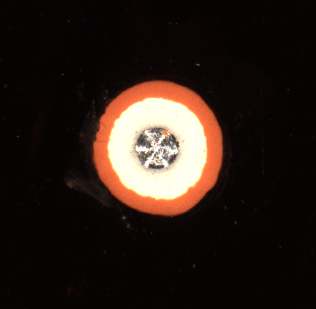
The Aesthetix camera images the crater from above. The user — or Aesthetix' automatic detection — places one circle on every visible ring boundary. The module then calculates each layer thickness from adjacent ring radii using:
with N concentric circles producing N − 1 layer thicknesses (outermost circle = top of the coating system, innermost circle = bottom of the deepest layer).
Required Tool: The Säberg Drill
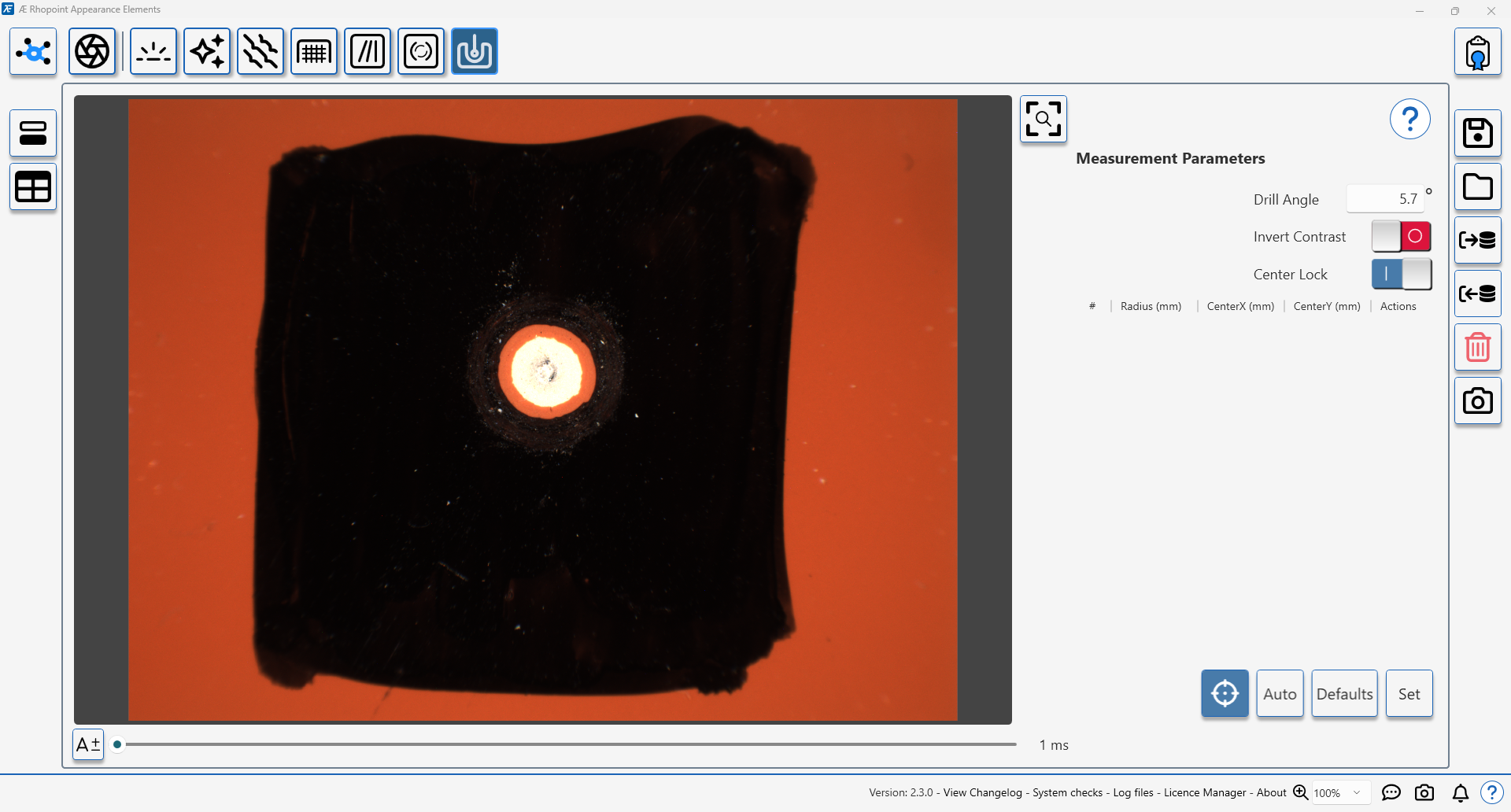
The Boring Thickness Module requires a separate, manually operated Säberg drill (sometimes called "drill grinder" or "PIG drill") to prepare the sample. The drill is not part of the Aesthetix system; commonly used bits have cone angles of 5.7°, 10°, 20° or 30°. The actual cone angle of the bit used must be entered as the Drill Angle parameter in Appearance Elements — see Boring Thickness Parameters.
When to Use This Module
- Determining the thickness of individual layers in a multi-layer coating stack
- Validating coating specifications layer-by-layer
- Calibrating or auditing non-destructive thickness gauges
- Investigating coating failures where layer-specific information is required
Considerations
Boring thickness measurement is destructive: the drill removes a small, conical area of coating down to the substrate. The measured area cannot be restored and the substrate is exposed at the drill site, requiring touch-up. Where a non-destructive total dry-film thickness measurement is sufficient, that method should be preferred and the boring method reserved for cases where layer resolution is needed.
Boring Thickness Module Documentation
- Boring Thickness Parameters — Drill Angle, Invert Image, Center Lock
- How to Measure with Boring Thickness Module — Standard automatic workflow
- Boring Thickness Manual Mode — Manual placement and editing of ring boundaries
- Boring Thickness Measurement Guide — Best practices, troubleshooting, edge cases